
A University of
Manchester Spinout



AI-Driven Stability Assessment for Modern Power Systems
Real-Time Stability Insights for Secure, Sustainable Power Systems
Grid Stability provides AI-driven stability assessment and insights for power systems in milliseconds, enabling real-time what-if scenario assessment, and faster decision-making for grid operators and planners as renewable energy, electric vehicles and heat pumps transform the electricity network.
By replacing slow, complex simulation workflows with rapid AI-driven assessments, Grid Stability Monitor helps maintain system security while supporting the transition to a lower-carbon energy future.
Key Benefits:
- AI-driven stability assessment
- Real-time operational insights
- Faster scenario screening
- Human-readable outputs
- Designed to complement existing operator workflows
Power Systems Are Becoming More Complex
Electricity networks are undergoing unprecedented change.
Every day, more renewable generation, battery systems, electric vehicles and heat pumps are connected to the grid. While these technologies are essential for decarbonisation, they also introduce new levels of complexity and uncertainty into power system operation.
System operators and planners must continuously assess grid stability to ensure reliable operation. Traditionally, this requires computationally intensive simulations that can be too slow for operational decision-making and increasingly difficult to scale across the vast number of possible scenarios that modern power systems present.
The result is a difficult balance between maintaining security, avoiding blackouts, managing costs and maximising the utilisation of low-carbon energy sources.
Introducing Grid Stability Monitor
Fast, AI-Driven Stability Assessment
Grid Stability Monitor uses machine learning to analyse power system stability and rapidly assess large numbers of operating scenarios.
The platform is designed to support both operational and planning activities by enabling:
- Near real-time stability assessment
- Rapid screening of large numbers of scenarios
- What-if contingency analysis
- Stability insights for operators and planners
- Confidence metrics and uncertainty quantification
- Human-readable outputs that support decision-making
Rather than replacing existing tools and processes, Grid Stability Monitor is designed to complement and enhance them.
Better Visibility. Better Decisions.
Grid Stability Monitor helps organisations navigate the increasing complexity of modern electricity networks by providing faster access to stability information.
Potential benefits include:
- Improved situational awareness
- More confident operational decision-making
- Enhanced understanding of stability boundaries
- Better utilisation of low and zero-carbon technologies
- More efficient procurement of stability-related services
- Support for secure grid operation during the energy transition
Projects and Award-Winning Innovation
Grid Stability is part of SPEN’s £5.76m strategic initiative, MOSAIC, focusing on modelling, analysis and simulation of modern power systems. Together with SPEN and key national and international partners (National HVDC Centre, University of Strathclyde/PNDC, University of Manchester, SuperGrid Institute, Universitat Politècnica de Catalunya (UPC)/Eroots, University of Cardiff) we are supporting the development and application of cutting-edge modelling, analysis, and simulation tools, tailored to the needs of the GB power system, bridging the gap between academic research and BAU operations.
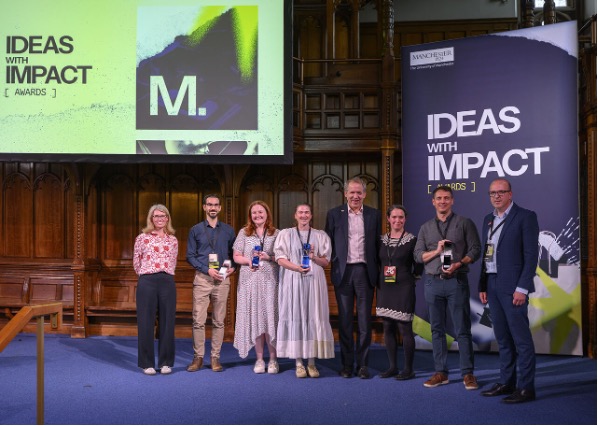
Grid Stability’s work has been recognised through the UK Government’s Manchester Prize, where the company was selected as a finalist and awarded £160,000 seed funding to support development of its technology. Moreover, Grid Stability was among the 5 winners of the Ideas with Impact 2026 competition, winning a £50,000 award.

Our Vision
Supporting the Transition to Net Zero
As power systems continue to evolve, operators need faster, more intelligent ways to assess stability and security.
Grid Stability provides the insights needed to support secure operation while enabling greater adoption of renewable and low-carbon technologies.
Our goal is simple:
Enable the transition to sustainable power systems while keeping the grid secure and the lights on.
Meet the Team

Panagiotis Papadopoulos
Panagiotis (Panos) is the Founder of Grid Stability and a Reader (Associate Prof.) and UKRI Future Leaders Fellow at the University of Manchester. He has over 12 years of experience in academia with expertise in the area of power system dynamics and machine learning applications and a research portfolio that includes collaboration with several industrial partners, research institutions and universities throughout the world.

Ifigeneia Lamprianidou
Ifigeneia is a Research Engineer at Grid Stability, specialising in power system dynamics and trustworthy machine learning. She develops frameworks that combine physics-based modelling with data-driven methods, including model discovery and explainable AI, delivering tools that are both technically rigorous and operationally trustworthy. Her expertise spans the stability of low-carbon power systems, dynamic security assessment, and the integration of inverter-based resources.

Alinane Brown
Alinane is a Research Engineer at Grid Stability and a Research Associate at the University of Manchester. His expertise spans power system stability, dynamic modelling, inverter-based resource integration, and the application of artificial intelligence (AI) to power systems, including reinforcement learning, formal AI verification and security-constrained optimisation.

Luke Benedetti
Luke is a Research Engineer at Grid Stability and a Research Associate at The University of Manchester. He has expertise in power system dynamic modelling, simulation, and analysis with a particular focus on oscillatory stability and interactions, and the impact of converter-interfaced devices. He also has experience applying machine learning methods to problems in the domain of power system dynamics.

Amlan Maity
Amlan is a Junior Research Engineer at Grid Stability and a PhD student at the University of Manchester. His expertise includes power system analysis and dynamics, as well as the application of artificial intelligence to power systems. He also has professional experience as a software developer working on Energy Management System (EMS) solutions.

Alexandros Paspatis
Alexandros is the Team Lead at Grid Stability and an academic (Senior Lecturer at Manchester Met) focusing on the impact of power electronics-interfaced resources on power systems. He has extensive experience in the simulation and laboratory validation of power systems, with expertise in hardware-in-the-loop simulation technologies.